
When do high-temp dishwashers beat low-temp models?
by
Published
Views:
For quality control and safety teams, the answer is straightforward: high-temp dishwashers beat low-temp models when hygiene validation, compliance confidence, and rush-hour consistency matter more than the lowest upfront or utility cost. In operations where food-contact safety must be easy to verify, where staff turnover makes chemical control less reliable, or where heavy soil loads and high rack volumes create constant process stress, thermal sanitization often delivers a more dependable margin of safety.
That does not mean high-temp machines are always the better buy. Low-temp units can perform well in smaller, less demanding environments, especially where utilities are limited and chemical programs are tightly managed. But for readers responsible for audits, sanitation records, and risk reduction, the real comparison is not hot water versus chemicals in theory. It is which system holds sanitation standards more consistently under real operating pressure.
The core search intent behind “when do high-temp dishwashers beat low-temp models” is practical decision support. Quality control and safety managers are not looking for a basic definition. They want to know in which operating conditions high-temp dishwashers provide measurable advantages, what risks they reduce, how they affect compliance, and whether the higher infrastructure burden is justified by lower sanitation uncertainty.
This article focuses on those decision points. Rather than repeating generic product differences, it examines where thermal sanitization creates operational value, where low-temp systems remain reasonable, and how to evaluate the trade-off through hygiene assurance, throughput, training burden, and total risk exposure.
What quality and safety teams usually need to know first
The first concern is normally not “Which machine washes better on paper?” It is “Which setup gives us fewer sanitation failures in daily use?” For quality control personnel, a warewashing system is only as strong as its weakest routine: rinse temperature, chemical concentration, contact time, deliming, staff behavior, or maintenance response.
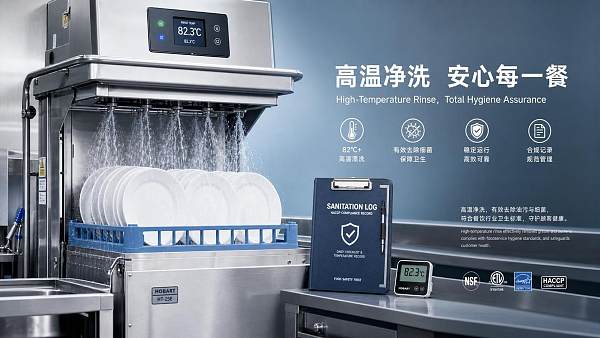
High-temp dishwashers gain an edge when an operation wants sanitization that is simpler to verify at the machine level. A properly functioning high-temp unit sanitizes through elevated final-rinse temperatures, reducing dependence on exact chemical dosing for every cycle. That matters in kitchens where execution varies by shift, by site, or by staffing stability.
Safety managers also care about defensibility. If an inspector, auditor, or internal investigator asks how food-contact wares are sanitized, a thermal process with measurable rinse conditions can be easier to explain, standardize, and document than a chemical program that depends on concentration control, dispenser performance, and operator checks.
When high-temp dishwashers clearly outperform low-temp models
High-temp dishwashers usually beat low-temp models in five situations: high-volume meal periods, frequent grease or protein soil, strict audit exposure, inconsistent labor execution, and operations where drying speed affects recontamination risk. In these settings, thermal sanitization offers benefits that are operational, not just technical.
First, high rack turnover favors high-temp systems. During peak service, dish rooms do not fail because a machine lacks a theoretical sanitizing method. They fail because performance becomes unstable under stress. High-temp units are often selected in larger commercial kitchens because they support rapid cycling and faster evaporation on dish surfaces, helping wares return to service sooner.
Second, heavy soil environments often gain from the stronger overall wash architecture typically associated with high-temp commercial machines. While detergent, pre-scrapping, and wash time still matter, restaurants handling greasy cookware, trays, and dense plate volume often prefer high-temp warewashing because it aligns with a more intensive sanitation workflow.
Third, high-temp machines are valuable where the cost of a sanitation deviation is high. Hospitals, institutional dining, school systems, chain restaurants with corporate standards, and facilities facing frequent third-party audits often prioritize systems that reduce reliance on perfect chemical handling. The higher the cost of a hygiene lapse, the more attractive thermal assurance becomes.
Fourth, staff variability changes the equation. A low-temp machine can sanitize effectively, but only if chemical concentration remains correct and verification routines are followed. In operations with high turnover, language barriers, rushed onboarding, or uneven supervision, that dependency can become a control weakness. High-temp dishwashers do not eliminate operator error, but they reduce one major variable.
Fifth, high-temp rinsing often improves drying performance. Faster drying is not just a convenience issue. Wet stacks and slow-drying wares can increase the chance of recontamination through handling, towel drying, or improper storage. For safety-focused teams, anything that supports cleaner air-drying and less touch after washing has practical value.
Why thermal sanitization can be easier to control than chemical sanitization
Low-temp dishwashers rely on chemical sanitizers, commonly chlorine or quaternary ammonium compounds, to achieve the required sanitation outcome. In a controlled environment, that can work well. The problem is that chemical sanitization is only as consistent as dosing accuracy, water conditions, dispenser function, and daily verification discipline.
Chemical concentration can drift because of clogged lines, empty containers, calibration errors, or unnoticed dispenser faults. Water hardness and temperature can also influence chemical performance. If test strips are not used correctly, or checks are skipped during a busy shift, the machine may appear operational while sanitation assurance quietly degrades.
High-temp dishwashers replace much of that uncertainty with a temperature-based sanitizing step. They still require maintenance, booster heater performance, and regular verification, but the control logic is often simpler for frontline teams to understand: the final rinse must reach the required sanitizing condition. When paired with gauges, digital readouts, or data logging, this can support more straightforward monitoring.
For quality systems, simpler control points are usually stronger control points. That is the real advantage. The issue is not that chemicals are inherently unreliable. It is that a sanitation program with fewer operator-dependent variables may hold up better across hundreds of shifts and multiple locations.
Compliance and audit confidence: where high-temp often has the upper hand
For safety managers, compliance is about proof as much as process. Local codes differ, and operators should always confirm applicable foodservice regulations, NSF requirements, and manufacturer specifications. Still, high-temp dishwashers often provide a compliance benefit because thermal sanitization is widely recognized, familiar to inspectors, and easier to align with standardized verification routines.
In multi-site operations, consistency matters more than isolated machine performance. A low-temp fleet may require robust chemical inventory control, standardized test-strip procedures, corrective-action logs, and strong site-level supervision. A high-temp fleet still needs preventive maintenance and temperature checks, but many organizations find the control structure easier to scale.
Audit confidence also improves when sanitation verification can be tied to machine performance records. If a unit logs rinse temperatures, cycle status, or alarm conditions, the site can move from “we believe the sanitizer was correct” to “we can demonstrate the machine met its sanitizing parameters.” That difference matters in investigations and customer assurance reviews.
For chain environments and regulated sectors, the value of high-temp dishwashers is often less about a single wash result and more about repeatable evidence. When auditors ask whether sanitation was consistently achieved, operations want objective signals, not assumptions.
Throughput, drying, and back-of-house flow under peak conditions
One reason high-temp dishwashers remain common in demanding foodservice environments is that warewashing is part of a larger production system. If dishes, utensils, and pans do not return quickly enough, the problem reaches service speed, labor efficiency, and even food safety, as teams may improvise with rushed turnover or poor staging.
High-temp models typically support better turnover in busy kitchens because wares exit hotter and dry faster. That can reduce rack congestion and help staff avoid practices that increase contamination risk, such as towel drying or stacking items while still wet. In practical terms, faster drying supports cleaner handling and smoother dish-room flow.
At very high volumes, small sanitation delays become large operational failures. If a low-temp machine requires closer chemical monitoring, slower drying management, or more frequent troubleshooting during rush periods, the sanitation method may be technically acceptable but operationally fragile. High-temp systems often win because they remain stable when the dish room becomes a bottleneck.
This is especially relevant for cafeterias, banquet facilities, quick-service chains, and institutional kitchens with narrow turnaround windows. In these environments, the best warewashing system is the one that preserves safe output when labor and volume are both under pressure.
Where low-temp dishwashers may still be the better fit
Although this article focuses on when high-temp dishwashers outperform, quality teams should avoid treating high-temp as the default answer in every case. Low-temp machines can be a rational and safe choice in smaller operations, satellite kitchens, bars, cafés, and sites where electrical or hot-water infrastructure makes high-temp installation difficult or expensive.
They can also work well when the operation has a disciplined chemical management program. If staff routinely verify sanitizer concentration, dispensers are maintained proactively, and audit pressure is modest, low-temp warewashing may deliver acceptable sanitation at a lower acquisition and utility cost.
Some wares are also better suited to lower-temperature handling. Certain plastics or heat-sensitive items may benefit from lower thermal exposure, depending on manufacturer guidance. For mixed-ware environments, that consideration can affect equipment strategy or require separate handling procedures.
The key point is not that low-temp is inferior. It is that low-temp depends more heavily on process discipline outside the machine’s heating system. If an operation can manage that discipline well, low-temp may remain fully viable.
The most useful decision framework for buyers responsible for risk
For quality control and safety teams, the best buying question is not “Which dishwasher is more powerful?” It is “Which system gives our operation the most reliable sanitation outcome with the least controllable risk?” That shifts the conversation from equipment features to process resilience.
Start with risk exposure. How serious would a sanitation failure be at this site? Consider menu type, consumer vulnerability, inspection frequency, and brand sensitivity. The higher the consequence of a hygiene lapse, the stronger the case for a high-temp dishwasher.
Next, assess labor reality. Are chemical checks performed correctly every shift? Is turnover high? Are multiple languages spoken in the dish area? Are supervisors consistently present? If execution discipline is uneven, high-temp systems may reduce sanitation variability.
Then review throughput pressure. How many racks per hour must the machine process during peaks? How often do wet wares create delays or handling issues? If warewashing regularly constrains operations, high-temp performance advantages become more meaningful.
Also examine utility and infrastructure trade-offs honestly. High-temp dishwashers often require booster heaters, stronger electrical service, or greater hot-water readiness. Those costs are real. But they should be weighed against the cost of sanitation deviations, failed audits, retraining, chemical errors, and service interruptions.
Finally, evaluate verification capability. Which machine can your team monitor more confidently every day? A theoretically lower-cost system may become more expensive if it creates repeated uncertainty, more manual checks, and greater dependence on human perfection.
What to ask vendors before making the final call
To make a sound decision, safety and quality teams should push beyond brochure claims. Ask vendors how the machine performs in your actual use case: racks per hour, soil load, water conditions, shift length, and labor profile. A sanitation system should be judged under realistic stress, not ideal conditions.
Ask what verification tools are built in. Does the machine display final rinse temperature clearly? Can it log data? Are alarms available for sanitizing failures? If low-temp, how is chemical concentration monitored, and how quickly can dispenser faults be detected?
Request preventive maintenance expectations in writing. High-temp dishwashers depend on heating performance and scaling control. Low-temp systems depend heavily on dispenser reliability and chemical supply integrity. Understanding which failure modes are most common helps quality teams prepare meaningful SOPs and corrective actions.
Also ask about drying outcomes, not just wash chemistry. If wares leave the machine wetter, how will the site prevent unsafe handling practices? Drying speed affects hygiene behavior more than many buyers initially realize.
Conclusion: when high-temp dishwashers truly win
High-temp dishwashers beat low-temp models when an operation needs sanitation that is easier to validate, less dependent on perfect chemical control, and more resilient during heavy-volume service. They are particularly strong in environments with strict compliance demands, high labor variability, significant soil loads, and strong pressure for rapid dish turnaround.
Low-temp machines still have a place, especially in smaller or infrastructure-limited operations with disciplined chemical management. But for quality control and safety managers, the deciding factor is usually not the machine’s purchase price. It is the confidence that sanitizing performance will remain consistent across every shift, every site, and every audit.
If your operation values reduced sanitation uncertainty, stronger verification, and smoother throughput under pressure, high-temp dishwashers often justify their added infrastructure demands. In risk-sensitive foodservice environments, that reliability advantage is where they most clearly outperform low-temp alternatives.
Recommended News
 Jun 19, 2026Flight-Type Dishwasher Freight Jumps 18% as LA/LB Congestion Reaches 37%Flight-type dishwasher freight jumps 18% as LA/LB congestion hits 37%, while California packaging rules add risk. See cost impacts, delay outlook, and key export actions now.
 Jun 18, 2026High-Temp Dishwashers Explained: Sanitizing Standards, Rinse Temperature, and ComplianceHigh-temp dishwashers explained: learn sanitizing standards, final rinse temperature targets, and compliance checks to reduce audit risk and improve kitchen hygiene performance.
 Jun 16, 2026Commercial Dishwashers for Restaurants: Purchase Costs, Daily Throughput, and ROI BenchmarksCommercial dishwashers for restaurants: compare purchase costs, daily throughput, and ROI benchmarks to find the best-fit machine, cut operating costs, and improve kitchen efficiency.
 Jun 16, 2026How to Choose High-Temp Dishwashers: Sanitizing Temperature, Cycle Time, and Vent NeedsHigh-temp dishwashers: learn how sanitizing temperature, cycle time, and vent needs affect compliance, throughput, and installation costs—choose the right system with confidence.
 Jun 15, 2026How to Choose Commercial Kitchen Washers by Rack Size, Throughput, and Water UseCommercial kitchen washers: learn how to compare rack size, throughput, and water use to improve hygiene, cut utility costs, and choose the right fit for busy kitchens.
 Jun 13, 2026June 22 Set for Supply Chain Expo With Flight-Type Dishwashers ZoneFlight-type Commercial Dishwashers take the spotlight at the June 22 Supply Chain Expo in Shanghai, where buyers can explore components, service networks, and global sourcing opportunities.
 Jun 12, 2026Supply Chain Expo Adds Flight-Type Dishwasher ZoneFlight-Type Commercial Dishwashers take center stage as Supply Chain Expo adds a dedicated warewashing zone. Explore compliance, sourcing, and market signals shaping smarter procurement.
 Jun 12, 2026Flight-Type Commercial Dishwashers for Restaurants: When High-Volume Kitchens Should UpgradeCommercial dishwashers for restaurants: learn when high-volume kitchens should upgrade to flight-type systems to boost speed, hygiene, labor efficiency, and long-term cost control.
 Jun 11, 2026Chain Expo 2026 Adds Dishwashing Supply ZoneChain Expo 2026 adds a dishwashing supply zone, spotlighting traceability, local sourcing, and supply chain resilience. See what buyers, OEMs, and suppliers should watch next.
 Jun 10, 2026Chain Expo 2026 Sets June 22 Opening With Dishwashing Supply Chain ZoneChain Expo 2026 opens June 22 in Beijing with a new dishwashing supply chain zone spotlighting Flight-type Commercial Dishwashers, core components, and sourcing trends buyers should watch.
 Jun 09, 2026Chain Expo 2026 Sets June 22 Opening, Adds Dishwashing Supply Chain ZoneChain Expo 2026 opens June 22 in Beijing with a new commercial kitchen supply chain zone spotlighting Flight-type Commercial Dishwashers, local sourcing, and shipping efficiency.
 Jun 07, 2026Flight-Type vs Rack-Type Commercial Dishwashers for Restaurants: Which Fits High-Volume Kitchens?Commercial dishwashers for restaurants compared: flight-type vs rack-type systems for high-volume kitchens. Discover the best fit for throughput, space, labor, and long-term cost.
 Jun 06, 2026How to Choose High-Speed Dishwashers for Restaurants: Capacity, Cycle Time, and UtilitiesHigh-speed dishwashers for restaurants: learn how to compare capacity, cycle time, utilities, and operating cost to choose a faster, cleaner, and more efficient fit.
 Jun 05, 2026Flight-Type Commercial Dishwashers vs Rack Machines: Which Fits High-Volume Kitchens?Commercial dishwashers compared: flight-type vs rack machines for high-volume kitchens. Discover which delivers better throughput, flexibility, hygiene control, and ROI.
![]() Jun 04, 2026Japan Probes Hot-Rolled Steel ImportsJapan Probes Hot-Rolled Steel Imports: learn how Japan’s anti-dumping investigation may reshape steel costs, equipment pricing, lead times and supply chain decisions for global exporters and buyers.
Jun 04, 2026Japan Probes Hot-Rolled Steel ImportsJapan Probes Hot-Rolled Steel Imports: learn how Japan’s anti-dumping investigation may reshape steel costs, equipment pricing, lead times and supply chain decisions for global exporters and buyers. Jun 02, 2026Industrial Dishwashers Price: What Drives Cost for High-Volume KitchensIndustrial dishwashers price depends on capacity, energy use, hygiene compliance, installation, and service. Learn how high-volume kitchens compare true lifecycle value.
 May 31, 2026How to size commercial dishwashers for restaurants?Commercial dishwashers for restaurants must match peak demand, workflow, and costs. Learn sizing formulas, machine types, and tips to boost hygiene and efficiency.
 May 27, 2026How commercial kitchen washers cut labor without missesCommercial kitchen washers cut labor by improving first-pass clean rates, reducing rewashes, and keeping dish flow fast, hygienic, and reliable during peak service.
![]() May 25, 2026When do high-temp dishwashers beat low-temp models?High-temp dishwashers outperform low-temp models when hygiene validation, audit confidence, and peak-hour consistency matter most. See when the extra investment pays off.
May 25, 2026When do high-temp dishwashers beat low-temp models?High-temp dishwashers outperform low-temp models when hygiene validation, audit confidence, and peak-hour consistency matter most. See when the extra investment pays off.![]() May 25, 2026US-Iran Talks Stall, Middle East Shipping Risks RiseUS-Iran talks stall—rising Middle East shipping risks impact flight-type commercial dishwasher logistics, freight costs & supply chain resilience. Act now.
May 25, 2026US-Iran Talks Stall, Middle East Shipping Risks RiseUS-Iran talks stall—rising Middle East shipping risks impact flight-type commercial dishwasher logistics, freight costs & supply chain resilience. Act now. May 24, 2026Hormuz Strait Transit Plummets 94%; Dishwasher Shipping Costs Surge $3,200Hormuz Strait transit down 94% — dishwasher shipping costs surge $3,200. Critical supply chain impact on commercial dishwasher exporters, importers & logistics providers.
 May 23, 2026Do high-speed dishwashers cut wait time or raise costs?High-speed dishwashers can speed service—or increase utility and maintenance costs. Learn how to compare throughput, labor, and total ownership cost before you buy.
 May 23, 2026Chile Enforces New Safety Standard for Flight-Type DishwashersChile enforces new flight-type dishwasher safety standard (INN NCh 3355.Of2026) from July 1, 2026—mandatory IEC-based certification, thermal cycling & mechanical testing required.

Editor's Selection
The Archive Newsletter
Critical industrial intelligence delivered every Tuesday. Peer-reviewed summaries of the week's most impactful logistics and market shifts.