
Zhejiang Trade Show Signals Payment Rules Shift
by
Published
Views:
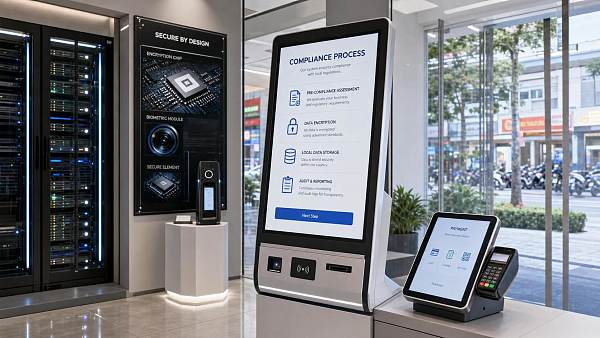
On June 4, 2026, the close of the Zhejiang Service Trade (Europe) exhibition highlighted a practical compliance and market-access development for smart retail equipment: Robotic Retail Terminals presented by eight fintech companies from Zhejiang were shown in alignment with mainstream European payment infrastructure through protocol adaptation with VISA and Mastercard, with explicit support for EMVCo 3DS 2.3 and SCA. For importers, exporters, retail technology suppliers, payment-facing equipment vendors, and compliance service providers, the development is worth attention because it points to a lower barrier in payment-rule adaptation, deployment documentation, and PCI DSS-related implementation costs rather than being just a product showcase.
What was confirmed at the Amsterdam exhibition
From June 2 to 4, eight fintech companies from Zhejiang presented a core Robotic Retail Terminals solution at the RAI Exhibition Centre in Amsterdam during a European fintech exhibition. During the event, they reached payment protocol adaptation cooperation with VISA and Mastercard. The solution focused on three modules: frictionless scan-to-open access, edge AI billing, and real-time multi-currency settlement. The event summary also stated explicit support for EMVCo 3DS 2.3 and SCA, and described this as formal access for Chinese smart retail terminals to mainstream European payment infrastructure, with a notable reduction in localization barriers for importers and in PCI DSS compliance costs.
Where the rule signal may start to affect execution
For importers and local deployment partners
From an industry perspective, these companies are likely to feel the effect first because payment compatibility is often a practical entry condition for deployment. If terminal solutions already align with EMVCo 3DS 2.3 and SCA requirements, the impact may appear in technical review, procurement screening, onboarding documentation, and local rollout planning. What deserves closer attention is whether buyers begin to treat payment-standard compatibility and related compliance evidence as a more explicit purchasing requirement.
For terminal exporters and equipment manufacturers
Analysis shows that exporters of smart retail terminals may need to pay closer attention to how product specifications, transaction logic, authentication flows, and security documentation are presented to overseas buyers. The relevance is not limited to hardware shipment; it also touches pre-sales technical alignment, tender support files, settlement capability descriptions, and post-delivery acceptance criteria. In practice, firms should watch whether protocol adaptation and authentication support become standard parts of export documentation and technical bid alignment.
For compliance, testing, and certification-related service providers
Observably, service providers involved in compliance review, testing support, and payment-security documentation may see rising demand for clearer evidence packages around SCA, EMVCo 3DS 2.3, and PCI DSS-related implementation. The impact is likely to be concentrated in document preparation, interface verification, deployment audit readiness, and buyer-facing explanatory materials. It is more appropriate to understand this as a signal that compliance work may move earlier in the sales and delivery cycle.
For channel operators and after-sales teams
For channel and service teams, the immediate issue is not only whether terminals can be sold, but whether they can be maintained and updated under the payment and authentication expectations attached to deployment. That may affect onboarding instructions, service-level arrangements, software update records, and traceability of configuration changes. Analysis shows that operational support could become more closely linked to compliance consistency after installation.
What companies should watch next in contracts and delivery
Check how compliance proof is requested
What deserves closer attention is whether buyers, importers, or channel partners begin to request more explicit technical and compliance materials tied to EMVCo 3DS 2.3, SCA, and PCI DSS-related deployment expectations. The event confirms support and adaptation cooperation, but it does not provide detailed execution standards, so companies should prepare for closer scrutiny without assuming a uniform market template already exists.
Review procurement and tender language
Analysis shows that procurement teams should monitor whether tender files, supplier qualification forms, and technical schedules start to include more direct wording on payment authentication, multi-currency settlement capability, and compatibility with mainstream payment infrastructure. This is especially relevant for firms positioning robotic retail terminals as export-ready solutions rather than stand-alone hardware products.
Prepare delivery files beyond hardware specifications
From an industry perspective, shipment readiness may increasingly depend on the completeness of technical files, interface descriptions, security process explanations, and post-deployment support documentation. The current information does not establish a new mandatory filing format, but it does suggest that delivery packages may need to be more payment-compliance oriented than before.
Track market feedback before treating it as settled practice
Observably, companies should avoid assuming that exhibition-level cooperation automatically means identical execution across all buyers or channels. What deserves closer attention is subsequent wording in contracts, acceptance checklists, partner qualification reviews, and market feedback on implementation difficulty, because those details will determine how far the rule signal translates into routine commercial practice.
Why this looks more like an execution signal than a finished rule change
Analysis shows that this development is best read as an execution-oriented signal tied to payment standards and market access conditions rather than as a newly published regulation in itself. The confirmed facts indicate practical alignment with mainstream payment infrastructure and recognized authentication expectations. However, the available information does not define a full regulatory timetable, an official enforcement document, or a uniform procurement rule across the market. For that reason, it is more appropriate to understand this as evidence of rule-compatible market entry becoming more operationally realistic, while detailed execution still requires observation.
How the market may interpret this development now
At this stage, the most balanced reading is that the exhibition outcome reduces some practical friction for Chinese smart retail terminals entering European payment-linked deployment scenarios. It does not by itself confirm that all compliance, procurement, and after-sales pathways are standardized, but it does suggest that payment adaptation, strong authentication support, and PCI DSS-related cost control are becoming more central to commercial acceptance. From an industry perspective, this is best treated as a concrete market-access signal with follow-up implications for documentation, procurement review, and delivery preparation.
Basis of this article and what still needs verification
This article is generated from the user-provided news title, event date, and event summary. For developments of this type, relevant source categories typically include official announcements, regulatory releases, trade or customs authority information, industry association updates, standard-setting organization documents, and reporting by established business or industry media. No specific official source link was provided in the input, so further verification remains necessary. What still needs ongoing observation includes any later official wording, implementation guidance, certification interpretation, procurement document changes, market feedback, and actual execution by participating companies and their business partners.
Recommended News
 Oct 24, 2026Choosing an Unmanned Retail Systems Supplier: Integration and Support ChecksChoosing an unmanned retail systems supplier? Discover integration tests, offline checks, and support requirements to reduce downtime and select a reliable partner before you scale.
 Oct 23, 2026TOMRA Signs to Become Preferred Reverse Vending Supplier for Major UK Retail ChainTOMRA signs a letter of intent for around 2,000 reverse vending machines for a major UK retailer. Explore what it could mean for procurement ahead of the expected 2027 deposit return scheme.
 Oct 07, 2026Where Smart Vending Solutions Deliver the Strongest ROI in Unattended RetailSmart vending solutions deliver stronger ROI in offices, transit hubs, hospitals, campuses, and residential communities. Discover how to choose profitable sites, formats, and operations.
 Oct 02, 2026AI Vending Technology Price: What Drives Upfront Costs and Operating ROI?AI vending technology price explained: compare upfront costs, recurring fees, and location-level ROI to make smarter unattended retail investments.
 Sep 30, 2026How to Evaluate a Smart Retail Kiosks Factory for Multi-Store DeploymentSmart retail kiosks factory evaluation guide for multi-store deployment—compare production consistency, system integration, remote management, quality control, and total cost of ownership.
 Oct 08, 2026How Can Smart Retail Technology Reduce Labor Without Hurting Experience?How do smart retail technologies reduce labor without hurting customer experience? Discover practical ways to automate routine tasks, resolve exceptions, and keep service seamless.
 Oct 03, 2026When does self-checkout vending ease queues during peak workplace breaks?Self-checkout vending eases peak workplace queues by speeding grab-and-go purchases. Discover the right setup, payment flow, and stock strategy for faster breaks.
 Sep 30, 2026What should you verify before choosing an unmanned vending machine company?Choose an unmanned vending machine company with confidence. Verify reliability, payment security, AI accuracy, compliance, service support, and total cost before you invest.
 Sep 11, 2026How to Evaluate a Smart Vending Machine Exporter for Multi-Market RolloutsSmart vending machines exporter evaluation guide for multi-market rollouts: assess compliance, payments, serviceability, software, and total operating cost.
 Sep 07, 2026How IoT-Connected Unmanned Vending Machines Improve Remote Monitoring and UptimeUnmanned vending machines IoT connected systems boost uptime through real-time telemetry, smart alerts, edge logic, and remote diagnostics. Learn how to prevent costly downtime.
 Aug 27, 2026How Edge AI Vending Cuts Transaction Latency in High-Traffic Retail LocationsEdge AI vending solutions low latency architectures speed checkout in high-traffic retail by processing baskets locally, reducing network delays, and improving shopper flow.
 Aug 24, 2026What Do Modern Commercial Civilization Solutions Mean for Smart Retail Investment?Modern commercial civilization solutions redefine smart retail investment through stronger cold chain control, POS resilience, hygiene stability, and unattended retail performance that scales profitably.
 Aug 11, 2026How to Evaluate Unmanned Vending Machines for Micro Markets by ROI and OperationsUnmanned vending machines for micro markets should be judged by ROI, labor, payment stability, shrink control, and service—not price alone. Learn what buyers must compare before investing.
 Aug 03, 2026Application Platform Guides: How to Choose the Right System for Self-Service Retail?Application guides platform insights for self-service retail: learn how to evaluate edge control, payments, integrations, and uptime to choose a reliable system with confidence.
 Jul 22, 2026Are AI-Powered Unmanned Vending Machines Worth It for 24/7 Retail Expansion?Unmanned vending machines AI powered solutions can unlock 24/7 retail growth. Discover when ROI, labor savings, and smarter site expansion make the investment worth it.
 Jul 14, 2026Unmanned Retail Technology in Southeast Asia: Market Drivers, Local Challenges, and Rollout ModelsUnmanned retail technology Southeast Asia is scaling fast. Explore market drivers, local barriers, and rollout models shaping smarter, resilient retail growth.
 Jul 13, 2026Vietnam Opens Retail Terminal Pre-Compliance PortalVietnam Opens Retail Terminal Pre-Compliance Portal: learn how Decree 12/2026/ND-CP affects robotic retail terminals, audits, penalties, and market-entry timing in Vietnam.
 Jul 11, 2026Unmanned Vending Machines for Micro Markets: Best Layouts, Payment Options, and Use CasesUnmanned vending machines for micro markets: explore the best layouts, payment options, and real-world use cases to improve traffic flow, uptime, and customer convenience.
 Jul 10, 2026Retail Automation Terminals for Barcode Scanning: Key Features to Compare Before You BuyRetail automation terminals barcode scanning: compare scan accuracy, durability, integration, and security to choose a faster, more reliable retail solution before you buy.
 Jul 08, 2026How Unmanned Operations Technology Works in Self-Checkout and Robotic RetailUnmanned operations technology powers self-checkout and robotic retail through AI, sensors, payments, and remote monitoring. Learn what drives accuracy, uptime, hygiene, and scalable growth.
![]() Jul 07, 2026Smart Unmanned Retail Systems Remote Management: Key Functions, Alerts, and Multi-Store ControlSmart unmanned retail systems remote management explained: discover key functions, critical alerts, and multi-store control strategies to improve uptime, compliance, and retail efficiency.
Jul 07, 2026Smart Unmanned Retail Systems Remote Management: Key Functions, Alerts, and Multi-Store ControlSmart unmanned retail systems remote management explained: discover key functions, critical alerts, and multi-store control strategies to improve uptime, compliance, and retail efficiency. Jul 05, 2026METI Tightens Logging Rules for Robotic Retail ImportsMETI tightens logging rules for robotic retail imports in Japan. Learn how real-time edge-AI calibration logs affect PSE renewal, compliance planning, and market access.
 Jul 04, 2026METI Sets Edge AI Log Rule for Retail RobotsMETI Sets Edge AI Log Rule for Retail Robots: learn how Japan’s 2026 compliance update affects robotic retail terminals, JIS export logs, retention duties, and market readiness.
 Jul 04, 2026Retail Equipment Solutions With Modular Shelving: What to Check Before BuyingRetail equipment solutions with modular shelving: learn what to check before buying, from load capacity and durability to compliance, modularity, and total cost.








Editor's Selection
The Archive Newsletter
Critical industrial intelligence delivered every Tuesday. Peer-reviewed summaries of the week's most impactful logistics and market shifts.