
Commercial Freezers: How to Avoid Temperature Drift
by
Published
Views:
For operators managing commercial freezers, temperature drift is not a small technical nuisance. It can trigger food safety exposure, inventory loss, compressor overwork, and rising utility costs. In retail, foodservice, vending, and cold display environments, stable cabinet temperature protects both product quality and operating margins. This guide explains how to identify, prevent, and correct temperature drift in commercial freezers with practical, checklist-based steps.
Why Commercial Freezers Need a Checklist Approach
Temperature drift rarely comes from one cause alone. In most commercial freezers, drift develops from a chain of small issues: poor airflow, door openings, dirty coils, sensor errors, bad loading habits, or delayed maintenance.
A checklist reduces guesswork. It helps teams verify the same critical points every day, spot deviations early, and respond before frozen goods enter a risky temperature zone. This method is especially useful in mixed commercial environments where cold chain reliability affects brand trust and compliance.
Core Checklist to Prevent Temperature Drift in Commercial Freezers
Use the following checklist to keep commercial freezers within target range and improve temperature recovery after normal operational disturbances.
- Check cabinet temperature against a calibrated reference thermometer at least twice daily, and compare product temperature, air temperature, and controller readings to catch hidden sensor drift early.
- Inspect door gaskets, frame alignment, and self-closing action every shift, because even a small air leak allows warm infiltration and forces longer compressor run cycles.
- Keep evaporator and condenser airflow paths clear by removing cartons, plastic wrap, dust, and debris that block heat exchange and reduce cooling stability inside the freezer.
- Load products with spacing between packs and away from discharge vents, so cold air can circulate evenly rather than forming warm pockets or localized frost buildup.
- Review defrost settings and timing regularly, since excessive defrost duration or failed termination controls can push commercial freezers above acceptable holding temperatures.
- Clean condenser coils on a scheduled basis, especially in dusty kitchens, loading zones, and retail back rooms where fouling quickly reduces cooling efficiency.
- Monitor door-opening frequency during peak traffic periods, because repeated access often causes temperature drift faster than equipment faults in high-turnover frozen storage.
- Verify probe placement and controller setpoints after service work, power interruptions, or product resets, since incorrect programming often creates false stability readings.
- Record alarms, recovery times, and recurring warm events in a simple log, making it easier to separate isolated incidents from developing mechanical problems.
- Service fan motors, hinges, heaters, and drain lines before failure, because preventive maintenance usually costs far less than spoiled stock and emergency repairs.
What Usually Causes Temperature Drift
Airflow Restrictions
Many commercial freezers drift because cold air cannot move as designed. Overstocking, blocked louvers, ice buildup, and dirty evaporator surfaces reduce circulation. The controller may show an acceptable number while product in the back or top zones warms unevenly.
Door and Seal Problems
Worn gaskets, misaligned doors, and weak closures let warm, moist air enter the cabinet. That air increases frost, lengthens pull-down time, and destabilizes internal temperature. In glass-door or reach-in units, this problem often appears gradually rather than as a sudden failure.
Heat Load Spikes
Newly loaded product, frequent restocking, nearby cooking equipment, or poor room ventilation can overwhelm freezer capacity. This is common in convenience retail, supermarket back rooms, and quick-service operations where ambient conditions fluctuate throughout the day.
Control or Sensor Errors
A faulty probe or incorrect setpoint can make commercial freezers appear stable when they are not. Calibration drift, poor sensor placement, and control board issues all create misleading readings that delay corrective action.
How the Checklist Changes by Application
Supermarket Display Freezers
Open or high-traffic display freezers are highly sensitive to ambient air movement. HVAC drafts, nearby entrances, and customer reach patterns can disrupt the cold air envelope. In these cases, focus on discharge air paths, case loading height, and recovery time after traffic peaks.
Night curtains, correct planogram spacing, and frequent coil cleaning often deliver better temperature consistency than repeated thermostat adjustments. For display equipment, airflow discipline matters as much as refrigeration capacity.
Back-of-House Storage Freezers
Storage units usually drift because of loading behavior and neglected maintenance. Products are stacked tightly, doors stay open during put-away, and drain lines or fans receive attention only after a visible issue appears.
Here, simple controls work best: limit door-open time, stage incoming stock before loading, and verify product temperature after large deliveries. These steps help commercial freezers recover faster and hold a narrower operating range.
Vending and Unmanned Retail Equipment
Smart freezers and unmanned frozen cabinets depend on both refrigeration performance and system data integrity. If sensors, door logs, or remote alarms are inaccurate, operators may miss early drift events entirely.
Remote temperature monitoring, alarm escalation rules, and faster field response are essential. In this scenario, commercial freezer reliability is partly an IoT management issue, not only a mechanical one.
Commonly Missed Risk Points
- Ignoring product temperature and relying only on display temperature can hide warm inventory inside densely packed commercial freezers.
- Placing hot or partially cooled goods directly into frozen storage can cause long recovery periods and stress the refrigeration system.
- Assuming alarms are nuisance events often delays response to repeated micro-drift patterns that signal real equipment deterioration.
- Skipping gasket replacement because doors still close visually can allow constant air leakage and severe frost-related performance loss.
- Overlooking room conditions such as poor ventilation, high humidity, or nearby heat sources can make freezer settings seem ineffective.
Practical Execution Steps
Start with a daily temperature verification routine. Use a calibrated reference thermometer and compare three values: controller display, return air, and product core temperature. Log the results at fixed times, especially after restocking and peak access periods.
Next, build a weekly inspection round for airflow, coils, gaskets, fan operation, frost patterns, and drain condition. If a freezer shows slower recovery than similar units, investigate immediately rather than lowering the setpoint.
For larger operations, use remote monitoring to trend data across sites. Repeated drift in the same equipment family may reveal installation, control logic, or maintenance interval issues. This is where intelligence-led asset management can improve uptime and total cost of ownership.
Summary and Next Actions
Avoiding temperature drift in commercial freezers depends on disciplined checks, clean airflow, accurate sensing, and fast response to small deviations. Most drift problems begin as manageable operational issues before they become product-loss events.
Use this checklist as a working standard. Verify temperatures daily, inspect airflow and seals weekly, review alarm patterns monthly, and correct loading habits continuously. In demanding retail and service environments, consistent freezer temperature is not accidental; it is the result of repeatable control.
Recommended News
 Jul 19, 2026How to Evaluate a Commercial Freezers Supplier for Quality, Lead Time, and Total CostCommercial freezers supplier evaluation starts with quality, lead time, compliance, and total cost. Learn how to compare suppliers, reduce risk, and choose with confidence.
 Jul 12, 2026EU Requires R290 for ULT Freezers After 2027EU requires R290 for ULT freezers after 2027. Learn how the new F-Gas amendment affects exports, customs clearance, and compliant buying for EU medical, biotech, and research markets.
 Jul 08, 2026EU F-Gas Phase-out Moves Up for New FreezersEU F-Gas phase-out moves up for new freezers, forcing EU-bound models after Jan 1, 2027 to use R744, R290 or A2L/A3 refrigerants. Learn the compliance, customs and supply chain risks now.
 Jun 23, 2026Commercial Freezers Explained: Upright vs Chest vs Display Models for Food Service UseCommercial freezers compared: upright, chest, and display models for food service. Learn how each affects access, temperature control, energy use, and smarter buying decisions.
 Jun 22, 2026China Opens Fast-Track Customs for Green Cold Chain ExportsChina opens fast-track customs for green cold chain exports, speeding Ultra-low Temp Freezers and CO2 Cascade Cold Rooms with R290/CO2 through pilot ports. See who benefits.
 Jun 19, 2026How to Choose Commercial Freezers for Cold Storage: Capacity, Temperature, and Energy UseCommercial freezers for cold storage: learn how to compare real capacity, temperature stability, and energy use to reduce spoilage, control costs, and choose the right unit with confidence.
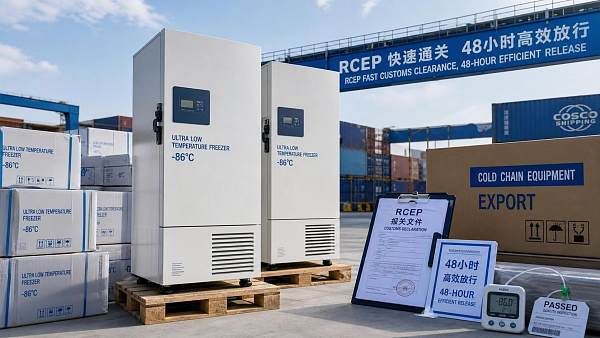
 Jun 16, 2026RCEP Fast-Track Opens for Ultra-low Temp FreezersUltra-low Temp Freezers gain faster RCEP customs clearance under the new fast-track. Learn how ISO 23453, origin certificates, and energy documents can cut release time to 48 hours.
 Jun 15, 2026RCEP Fast Track Gives Ultra-Low Temp Freezers 48-Hour ReleaseRCEP Fast Track accelerates Ultra-Low Temp Freezers clearance to 48 hours. Learn how compliant CO2/R290 models can speed market entry and cut inventory pressure across Asia-Pacific.
 Jun 14, 2026RCEP Fast-Track Opens for Ultra-low Temp FreezersUltra-low Temp Freezers gain a 48-hour RCEP fast-track via EN 16829 certification and carbon footprint documents. See what exporters, buyers, and logistics teams must prepare now.
 Jun 13, 2026RCEP Fast-Track Clears Ultra-Low Temp Freezers in 48 HoursRCEP fast-track helps Ultra-low Temp Freezers clear customs in 48 hours at key hub ports. See how ISO 23439:2025 compliance can speed delivery, reduce delays, and improve market access.
 Jun 12, 2026How to Choose Commercial Freezers for Retail or Foodservice: Size, Temperature, and Energy UseCommercial freezers buying guide for retail and foodservice: learn how to compare size, temperature stability, and energy use to reduce costs and choose the right unit with confidence.
 Jun 11, 2026R290 ULT freezer export approvals enter fast trackR290 ULT freezer export approvals enter fast track as China’s first whitelist links dual-standard compliance to faster inspection, market access, and smoother overseas delivery.
 Jun 10, 2026R290 Ultra-Low Temp Freezers Gain Export Fast-TrackR290 ultra-low temp freezers gain export fast-track support in China, opening new opportunities in medical cold-chain exports with faster certification and tax rebate advantages.
 Jun 09, 2026R290 ULT Freezer Export Certification Path OpensR290 ULT Freezer export certification path opens with a new dual-standard route and green channel. Learn what UL 61010-2-040 and IEC 60335-2-24 mean for faster compliance and export planning.
 Jun 08, 2026R290 Shift Gains Pace as ULT Freezer Export Window OpensR290 shift accelerates as the ULT freezer export window opens. Learn how R290 certification, R404A/R507 risks, and 2027 EU, Australia, and Singapore rules may impact market access.
 Jun 05, 2026WTO Cuts 2026 Trade Growth; Delivery Times StretchWTO cuts 2026 trade growth to 1.9% as delivery times stretch and freight surcharges rise. Learn how FOB/CIF terms, lead times, and cold-chain export contracts should adapt now.
![]() Jun 04, 2026EU ICS2 Rule Hits Cold Chain Equipment on June 1EU ICS2 rule hits cold chain equipment on June 1, 2026. Learn how ENS filing affects EU-bound shipments, customs timing, costs, and delivery reliability.
Jun 04, 2026EU ICS2 Rule Hits Cold Chain Equipment on June 1EU ICS2 rule hits cold chain equipment on June 1, 2026. Learn how ENS filing affects EU-bound shipments, customs timing, costs, and delivery reliability. Jun 03, 2026EU F-Gas Revision Raises R290 Export RequirementsEU F-Gas Revision raises R290 export requirements for commercial refrigeration. Learn key certification, labeling, and customs risks before shipping to the EU.
 Jun 03, 2026Eco-Refrigerant Freezers: How to Compare GWP, Safety Class and Energy UseEco-refrigerant freezers explained: compare GWP, safety class, and real-world energy use to cut costs, stay compliant, and protect food quality.
 Jun 02, 2026EU F-Gas Rule Hits Ultra-Low Freezer ExportsEU F-Gas Rule reshapes ultra-low freezer exports: learn how R290 certification, 0.5 g/year leakage tests, and CE access affect EU market readiness.
 Jun 01, 2026Commercial freezers can hide food safety risksCommercial freezers can hide temperature drift, airflow issues, and food safety risks. Learn how smarter monitoring and maintenance protect products, audits, and profits.
![]() May 31, 2026Are commercial freezers raising your energy bills?Commercial freezers may be driving up energy bills. Learn how to cut hidden kWh waste, reduce downtime, and make smarter TCO-based refrigeration decisions.
May 31, 2026Are commercial freezers raising your energy bills?Commercial freezers may be driving up energy bills. Learn how to cut hidden kWh waste, reduce downtime, and make smarter TCO-based refrigeration decisions. May 22, 2026Chemspec Europe 2026 Highlights Commercial Cold Chain & Smart POSChemspec Europe 2026 spotlighted Commercial Cold Chain & Smart POS — driving EU food safety, traceability & retail efficiency. Discover key compliance and integration insights.
 May 22, 2026When do commercial freezers for cold storage pay back?Commercial freezers for cold storage pay back faster when energy savings, lower spoilage, and reduced downtime align. Explore ROI by retail, foodservice, logistics, and healthcare scenarios.


Editor's Selection
The Archive Newsletter
Critical industrial intelligence delivered every Tuesday. Peer-reviewed summaries of the week's most impactful logistics and market shifts.