
ISO Triple Certification Becomes Retail Bid Gatekeeper
by
Published
Views:
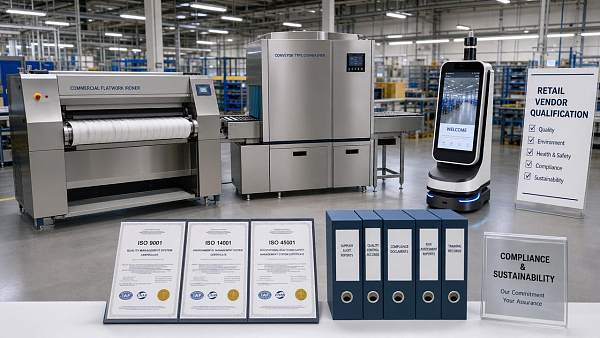
The timing of the underlying event is not explicitly stated, but 2026 Q1 industry monitoring indicates a clear procurement shift: 92% of the world’s Top 100 retailers now treat ISO 9001, ISO 14001, and ISO 45001 as mandatory supplier bidding qualifications. The requirement is already affecting export-oriented suppliers of high-frequency commercial equipment, including Commercial Flatwork Ironers, Flight-type Commercial Dishwashers, and Robotic Retail Terminals. For manufacturers, exporters, and supply-chain teams serving major retail channels, this matters because the issue is no longer only whether a certificate exists, but whether the management system behind it can withstand review.
What the monitoring data confirms
According to the information provided, 2026 Q1 industry monitoring shows that 92% of global Top 100 retailers have made ISO 9001/14001/45001 certification a compulsory condition for supplier bids. The trend has already extended to frequently purchased commercial equipment categories such as Commercial Flatwork Ironers, Flight-type Commercial Dishwashers, and Robotic Retail Terminals.
The same information states that small and medium-sized enterprises without valid certificates will directly lose access to tender opportunities through channels such as Walmart, Aldi, and Carrefour. It also notes that 87% of non-compliance cases found in certification spot checks stem from a disconnect between documented procedures and actual operations.
Where the pressure is likely to land first
Export manufacturers face a qualification barrier before pricing is even discussed
From an industry perspective, the most immediate impact is on manufacturers and exporters targeting large retail accounts. If triple certification is treated as a mandatory bidding threshold, access to procurement programs may be blocked at the pre-qualification stage rather than lost later on technical or commercial terms. This is especially relevant for suppliers of commercial laundry, commercial warewashing, and smart terminal equipment already named within the monitored scope.
SMEs may feel the effect most sharply in channel access
Analysis shows that small and medium-sized suppliers are the group most directly exposed when certification becomes a hard entry requirement. The reason is straightforward: without a valid certificate, the issue is not reduced competitiveness but outright exclusion from specific tenders. What deserves closer attention is that this affects not only new business development, but also pipeline planning, distributor coordination, and export order visibility.
Procurement and channel teams will need to verify more than paperwork
For retailers, importers, and channel-side sourcing teams, the monitoring result on non-compliance is significant. If 87% of spot-check failures come from a mismatch between documents and real operations, supplier qualification work cannot stop at collecting certificates. The practical pressure point is likely to shift toward audit readiness, record consistency, and whether operating processes align with declared system requirements.
Service and supply-chain partners may also see tighter documentation demands
Observably, the move affects more than the factory floor. Supply-chain service providers, quality coordinators, and delivery teams may all need to align more closely on records, procedures, and communication with customers. Where bids involve installation, commissioning, after-sales support, or multi-site delivery, documentation discipline may become part of commercial risk control rather than a purely compliance task.
What companies should review now
Check whether certificates are valid and usable for live tenders
Companies serving major retail channels should first confirm whether their ISO 9001, ISO 14001, and ISO 45001 certificates are valid, current, and recognized for bidding purposes in target accounts. Based on the provided information, lacking valid certificates can directly remove a supplier from tender access, so this is a basic eligibility review rather than an optional compliance exercise.
Test whether documented processes match day-to-day execution
What deserves closer attention is the gap highlighted by the spot-check findings. Since most non-compliance cases in the provided monitoring data came from inconsistency between written documents and actual operation, companies should not assume that certification alone is enough. Internal reviews should focus on whether procedures, records, and on-site practice tell the same story.
Prioritize affected product lines and retail-facing business units
Analysis shows that companies involved in Commercial Flatwork Ironers, Flight-type Commercial Dishwashers, and Robotic Retail Terminals should pay particular attention because these categories are already identified within the trend. In practice, this means reviewing tender preparation, customer qualification files, and supply readiness first in the business units most exposed to large retail procurement.
Prepare for customer communication around system implementation, not only certificate submission
For sales, account management, and tender teams, an important distinction is emerging between holding a certificate and demonstrating system implementation. Customer-facing teams may need to coordinate more closely with quality and operations functions so that responses to qualification requests are supported by consistent internal evidence, not just formal credentials.
Why this looks more like a structural procurement signal
As an observation, this development is better understood as more than a short-lived document requirement. The combination of a high adoption rate among Top 100 retailers, named coverage across specific equipment categories, and the high share of spot-check failures tied to operational inconsistency suggests a deeper emphasis on supplier system credibility. That said, it would be premature to generalize beyond the information provided or to treat every downstream market as already aligned in the same way.
Observably, the most important signal is that supplier qualification standards in major retail channels are being interpreted through both certification status and implementation quality. In that sense, the issue is not simply market access through paperwork, but market access through verifiable management practice.
How to read the current shift
Based on the information provided, the immediate takeaway is clear: for exporters of commercial laundry equipment, commercial dishwashing systems, and robotic retail terminals, ISO 9001/14001/45001 certification is increasingly functioning as a frontline bidding condition in major retail channels. The more nuanced takeaway is that certification alone does not resolve compliance risk if operating reality does not match documented systems.
It is more appropriate to understand this as an already material procurement signal with longer-term implications, while still leaving room for continued verification of how individual retailers apply it across categories and tenders.
Basis of this article and points for follow-up
This article is based on the user-provided news title, unspecified event timing, and the supplied event summary. No specific official source link was included in the input, so any underlying official references still require continued verification. For this type of industry development, relevant source categories would typically include official retailer procurement notices, corporate announcements, industry association updates, authoritative media coverage, and standard or certification-related documents. Follow-up attention should remain on whether retailer wording changes, how bid requirements are applied by category, and whether implementation checks continue to focus on gaps between documented systems and actual operations.
Recommended News
 Oct 12, 2026How to Size Gas-Heated Industrial Drying Machines for Laundry ThroughputIndustrial drying machines gas heated: learn how to size capacity for peak laundry throughput, moisture removal, airflow, and reliable operations.
 Oct 11, 2026Linen Processing Equipment Prices: Cost Drivers and Budget Benchmarks for BuyersLinen processing equipment price guide: explore cost drivers, budget benchmarks, throughput planning, utility needs, and smart buying tips for efficient laundry operations.
 Oct 06, 2026How Often Should Commercial Laundry Equipment Be Serviced?How often should commercial laundry equipment be serviced? Discover practical daily, monthly, and professional maintenance schedules to reduce downtime, improve safety, and extend equipment life.
 Sep 05, 2026How to Choose a Hotel Laundry Equipment Set for Capacity, Space, and Cost ControlHotel laundry equipment set guide: balance peak linen capacity, workflow space, utilities, and lifecycle costs to improve efficiency and control operating expenses.
 Jul 14, 2026Linen Laundry Systems for Hotels: How to Size Capacity, Workflow, and Utility DemandLinen laundry systems for hotels: learn how to size capacity, streamline workflow, and estimate utility demand to cut costs, avoid bottlenecks, and improve linen quality.
 Jun 28, 2026Linen Processing Equipment Middle East: What Buyers Should Check Before OrderingLinen processing equipment Middle East buyers should verify throughput, utilities, fabric care, TCO, and local support before ordering to reduce downtime and protect ROI.
 Jun 05, 2026ISO Triple Certification Becomes Retail Bid GatekeeperISO Triple Certification is now a retail bid gatekeeper. Discover how ISO 9001, ISO 14001, and ISO 45001 are reshaping supplier access, compliance, and export opportunities.
 Jun 03, 2026ICS2 ENS Rule Hits EU-Bound Rail FreightICS2 ENS rules for EU-bound rail freight start 2026-06-01. Learn how exporters can avoid border detention, penalties, and shipment delays.
 Jun 01, 2026How to choose commercial laundry equipment wiselyCommercial laundry equipment buying guide: compare capacity, efficiency, hygiene, automation, and service support to reduce costs and choose smarter long-term solutions.
 May 23, 2026Saudi Arabia Tightens Efficiency Standards for Commercial Flatwork IronersSaudi Arabia tightens efficiency standards for commercial flatwork ironers: IE5 motors & 100-hour steam stability testing required by 1 Sep 2026. Act now!







Editor's Selection
The Archive Newsletter
Critical industrial intelligence delivered every Tuesday. Peer-reviewed summaries of the week's most impactful logistics and market shifts.