
Industrial Washers: Soft-Mount vs Hard-Mount in 2026
by
Published
Views:
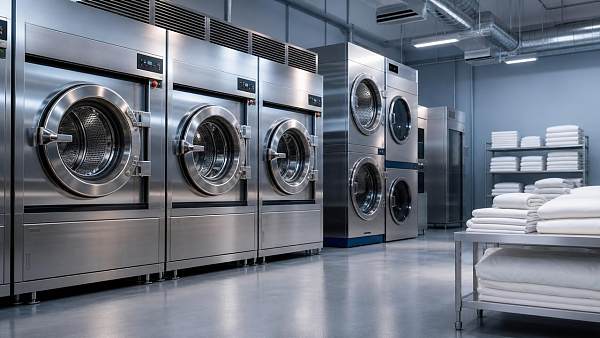
Choosing between soft-mount and hard-mount industrial washers in 2026 is no longer a narrow equipment choice. It now shapes installation budgets, vibration control, utility use, uptime, and long-term asset value.
Across hotels, healthcare linen plants, on-premise laundries, and mixed-service facilities, industrial washers are under pressure to deliver higher throughput with lower energy and labor intensity.
That shift matters to the broader commercial systems landscape followed by CRSS. Laundry equipment now connects with sustainability targets, facility engineering, and data-driven service reliability.
Why the industrial washers decision looks different in 2026
The soft-mount versus hard-mount debate has existed for years. In 2026, however, several market signals are changing how industrial washers are evaluated.
Construction costs remain elevated in many regions. Retrofit projects face tighter structural limits, making foundation requirements far more important than before.
At the same time, utility prices continue to push operators toward lower water use, faster extraction, and reduced dryer dependency. Wash process efficiency now matters beyond the laundry room.
Another signal is labor compression. Sites increasingly prefer industrial washers that simplify programming, reduce rewash risk, and minimize vibration-related interruptions.
The result is clear: industrial washers are being judged as infrastructure assets, not just wash machines.
The key difference between soft-mount and hard-mount industrial washers
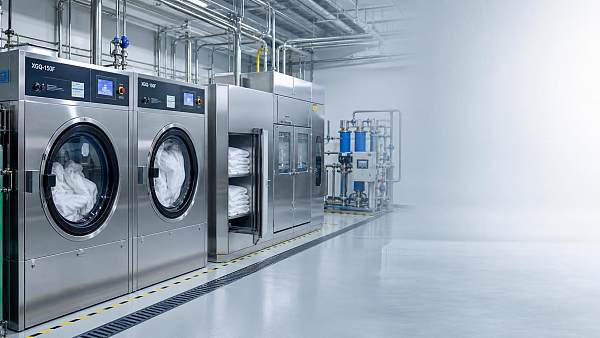
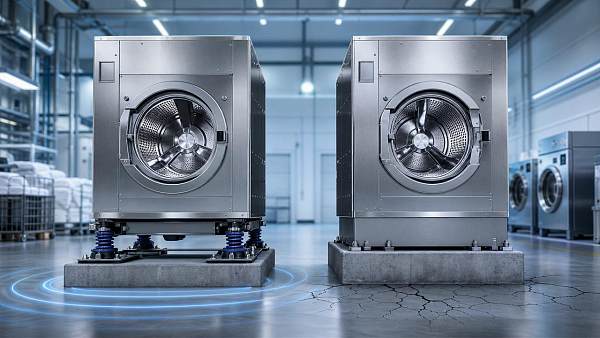
Soft-mount industrial washers use suspension systems, usually springs and shock absorbers. They absorb much of the force generated during high-speed extraction.
Hard-mount industrial washers are rigidly anchored to the floor or a reinforced base. They transfer much more extraction force into the building structure.
That basic design difference affects installation, cycle performance, vibration, maintenance strategy, and total cost of ownership.
What is driving the shift toward closer comparison of industrial washers
The 2026 market is not simply rewarding the lowest machine price. It is rewarding fit, resilience, and measurable operating efficiency.
- Higher building retrofit activity increases focus on floor loading and vibration transmission.
- Rising energy costs make higher extraction performance more valuable.
- Water and wastewater charges push facilities toward optimized wash cycles.
- Digital controls improve cycle consistency, making machine stability more important.
- Sustainability reporting raises attention on dryer energy, not just washer consumption.
- Uptime expectations increase as commercial service chains reduce spare equipment capacity.
These drivers explain why industrial washers are now assessed across the full linen flow, from wash extraction to drying, handling, maintenance, and utility billing.
Where soft-mount industrial washers are gaining advantage
Soft-mount industrial washers are increasingly favored in upper-floor laundries, renovation projects, and sites with strict vibration limits.
Because these industrial washers can often achieve higher G-force extraction, they remove more residual moisture before drying. That lowers downstream dryer time and can reduce heat energy consumption.
This benefit is especially relevant in hospitality and healthcare operations, where daily linen volume is high and dryer bottlenecks damage turnaround speed.
Typical strengths of soft-mount systems
- Better vibration isolation for sensitive buildings.
- Potentially easier placement in retrofitted facilities.
- Higher extraction can support lower dryer utility cost.
- Improved comfort in facilities where noise and motion matter.
The trade-off is usually a higher initial machine price and more attention to suspension component maintenance over the equipment life cycle.
Why hard-mount industrial washers still hold strong value
Hard-mount industrial washers remain highly relevant in 2026. They are often well suited to ground-floor plants, purpose-built laundry rooms, and cost-sensitive replacement projects.
Where reinforced concrete foundations already exist, hard-mount industrial washers can provide reliable performance with a lower purchase cost.
Their mechanical simplicity can also appeal in operations that prioritize ruggedness and standardized service routines.
Typical strengths of hard-mount systems
- Lower upfront equipment investment in many cases.
- Strong fit for new builds with designed foundations.
- Often easier to evaluate in traditional laundry layouts.
- Good option where extraction speed is not the main cost driver.
The limitation is that installation errors or underestimated floor requirements can create vibration issues, structural stress, and higher project cost later.
How the choice affects different business environments
Not all facilities benefit from the same industrial washers configuration. The right answer depends on building conditions, process flow, and operating economics.
For integrated service sites, the washer decision also affects dryer scheduling, labor pacing, room acoustics, and preventive maintenance planning.
What deserves closer attention before selecting industrial washers
In 2026, the smartest comparisons go beyond capacity and price. Several evaluation points are now essential.
- Building structure: verify slab thickness, reinforcement, and allowable vibration levels.
- Extraction economics: calculate dryer time saved by higher spin performance.
- Utility profile: compare water, sewer, gas, and electricity impact together.
- Maintenance capability: match machine complexity with actual service support.
- Cycle mix: evaluate sheets, towels, uniforms, microfiber, and specialty textiles separately.
- Control integration: confirm data visibility for error tracking and process consistency.
These checks help prevent a common mistake: buying industrial washers that fit the budget but fail the building or the process.
A practical way to judge long-term ROI in industrial washers
A useful 2026 approach is to compare industrial washers through lifecycle cost, not purchase price alone.
- Estimate installation cost, including foundation, anchoring, freight, and room modification.
- Project utility use across washing and drying, not only the washer cycle.
- Include expected maintenance parts, downtime risk, and service availability.
- Measure productivity effects, especially cycle completion and linen turnaround.
- Review replacement flexibility if layout or demand changes later.
In many cases, soft-mount industrial washers win on operational efficiency. In others, hard-mount industrial washers remain the more rational capital choice.
The best answer comes from matching equipment physics with facility reality.
The 2026 bottom line for soft-mount vs hard-mount industrial washers
The market is moving away from one-size-fits-all decisions. Industrial washers are now selected through a broader lens that includes construction constraints, energy strategy, and uptime resilience.
Soft-mount models are gaining momentum where vibration control, retrofit flexibility, and dryer savings create measurable value. Hard-mount models remain competitive where foundations are robust and capital discipline is decisive.
A strong next step is to compare industrial washers with a site-specific matrix covering structure, extraction targets, utility costs, maintenance support, and throughput goals.
That method leads to a lower-risk decision and a more durable return in 2026 and beyond.
Recommended News
 Aug 30, 2026How High-Frequency Commercial Washers Cut Energy Use in High-Volume LaundriesDiscover how high-frequency commercial washers energy saving strategies reduce water, heat, and drying costs while maintaining hygiene and throughput in high-volume laundries.
 Jul 11, 2026Industrial Washer Extractors Price Guide: What Affects Cost and Total Ownership?Industrial washer extractors price explained: compare cost drivers, price ranges, and total ownership factors to choose a machine that saves more over time.
 Jul 09, 2026Commercial Laundry Equipment for Nursing Homes: Washer and Dryer Sizing by Resident LoadCommercial laundry equipment for nursing homes should match resident load, linen volume, and staffing. Learn how to size washers and dryers for reliable throughput, hygiene, and lower operating costs.
 Jul 08, 2026Shanghai Port Improves, But Laundry Exports Still LagShanghai Port improves, but laundry exports still lag as soft-mount washer extractors and dry cleaners face 22-day delays. See what component shortages mean for buyers and suppliers.
 Jul 05, 2026How to Evaluate a High-Frequency Laundry Supplier for Hotels and HealthcareHigh-frequency laundry supplier selection affects hygiene, uptime, and cost. Learn how hotels and healthcare teams compare durability, compliance, service, and TCO.
 Jul 01, 2026High Frequency Laundry Equipment Price Guide: What Drives Cost and ROI?High frequency laundry equipment price explained: discover what drives cost, hidden expenses, and how to measure ROI, uptime, and long-term savings before you buy.
 Jun 30, 2026How to Evaluate an Air Suspension Industrial Washers Exporter for Stable OEM SupplyAir suspension industrial washers exporter selection starts with proof, not promises. Learn how to assess OEM supply stability, compliance, quality control, and warranty support before you buy.
 Jun 30, 2026Commercial Laundry Equipment Installation: Site Requirements, Utilities, and Common MistakesCommercial laundry equipment installation guide covering site requirements, utilities, drainage, ventilation, and common mistakes to help improve safety, uptime, and project performance.
 Jun 24, 2026How to Choose High-Frequency Laundry Systems for Hotels, Hospitals, and LaundromatsHigh-frequency laundry buying guide for hotels, hospitals, and laundromats. Compare capacity, hygiene, uptime, and lifecycle cost to choose a smarter system.
 Jun 23, 2026Industrial Washers Not Cleaning Properly? 7 Common Causes and How to Fix ThemIndustrial washers not cleaning properly? Discover 7 common causes—from dosing and temperature to loading and drainage—and learn practical fixes to cut rewash costs fast.
 Jun 18, 2026Commercial Laundry Equipment Cost Breakdown: What Drives CAPEX, Utilities, and Service NeedsCommercial laundry equipment cost goes beyond machine price. Learn what drives CAPEX, utilities, maintenance, and downtime to compare quotes wisely and lower total ownership cost.
 Jun 16, 2026Industrial Laundry Machines for Hotels and Hospitals: Capacity, Utility Load, and Workflow FitIndustrial laundry machines for hotels and hospitals: compare capacity, utility load, hygiene needs, and workflow fit to choose efficient systems that reduce bottlenecks and support reliable daily operations.
 Jun 15, 2026Commercial Laundry Equipment Costs: What Drives ROI for Hotels, Clinics, and LaundriesCommercial laundry equipment costs vary far beyond purchase price. Discover what drives ROI for hotels, clinics, and laundries, from extraction and utilities to uptime and service.
 Jun 11, 2026Industrial Washers for Hotels: How to Size Loads, Cycle Time, and Utility DemandIndustrial washers for hotels: learn how to size loads, shorten cycle time, and plan utility demand for better laundry efficiency, lower costs, and smarter hotel operations.
 Jun 10, 2026Industrial Laundry Machines: Key Capacity, Extraction, and Utility Factors for Plant BuyersIndustrial laundry machines for plant buyers: compare capacity, extraction, utilities, and controls to cut operating costs, improve throughput, and choose the right system with confidence.
![]() Jun 09, 2026How to Evaluate an Industrial Laundry Machines Supplier for Capacity, Service, and ROIIndustrial laundry machines supplier evaluation made simple: compare capacity, service response, and lifecycle ROI to choose a reliable partner and reduce downtime, costs, and risk.
Jun 09, 2026How to Evaluate an Industrial Laundry Machines Supplier for Capacity, Service, and ROIIndustrial laundry machines supplier evaluation made simple: compare capacity, service response, and lifecycle ROI to choose a reliable partner and reduce downtime, costs, and risk. Jun 01, 2026Are industrial washers for hotels worth the upgrade?Industrial washers for hotels can cut laundry costs, improve hygiene, protect linens, and boost throughput. Learn when upgrading delivers real ROI.
 May 26, 2026What to check before buying commercial laundry systemsCommercial laundry systems buying guide: learn what to check for capacity, utility fit, hygiene, durability, and lifecycle cost before you invest in a reliable, efficient setup.
 May 22, 2026How commercial laundry equipment affects daily throughputCommercial laundry equipment directly impacts daily throughput, labor efficiency, and linen quality. Learn how to reduce bottlenecks, cut downtime, and improve laundry performance.
 May 20, 2026Industrial Washers: Soft-Mount vs Hard-Mount in 2026Industrial washers in 2026: compare soft-mount vs hard-mount for vibration, installation cost, energy savings, and ROI to choose the best fit for your facility.
 May 20, 2026Industrial Laundry Machines: Downtime Causes and FixesIndustrial laundry machines downtime guide: learn the top failure causes, practical fixes, and checklist-based maintenance steps to restore uptime faster and reduce repeat breakdowns.


Editor's Selection
The Archive Newsletter
Critical industrial intelligence delivered every Tuesday. Peer-reviewed summaries of the week's most impactful logistics and market shifts.