
Retail Edge Computing for Stores: Best Use Cases for POS, Vision AI, and Inventory
by
Published
Views:
Retail Edge Computing for Stores: Best Use Cases for POS, Vision AI, and Inventory
Retail edge computing is moving from pilot projects to core store infrastructure.
Stores now need instant processing, stable uptime, and local intelligence.
That pressure is strongest in checkout, computer vision, and inventory operations.
Cloud platforms still matter, but many store decisions cannot wait for round trips.
A card authorization delay, a missed shelf alert, or a failed smart fridge session directly affects revenue.
This is where retail edge computing creates real business value.
It places compute power close to devices, transactions, and customer interactions.
In practical terms, that means faster POS response, more reliable Vision AI, and near real-time inventory visibility.
For retailers managing cold chains, unmanned terminals, and service equipment, local processing also reduces operational blind spots.
Why retail edge computing matters now
The store has become a dense, real-time data environment.
POS terminals, barcode printers, cameras, sensors, freezers, kiosks, and payment devices all generate constant signals.
Sending every event to the cloud creates latency, bandwidth costs, and avoidable failure points.
More importantly, stores cannot afford downtime during peak traffic or weak-network conditions.
Retail edge computing solves this by keeping critical decisions local.
It supports low-latency transactions, local model inference, and resilient device orchestration.
The cloud still handles training, analytics, and multi-site reporting, but the store keeps operating even when connectivity drops.
Several business shifts make this urgent:
- Self-checkout and contactless payment increase demand for sub-second processing.
- Vision AI is expanding into unmanned retail, queue analysis, loss prevention, and shelf compliance.
- Inventory accuracy now depends on live data from stores, not overnight batch uploads.
- Food safety, refrigeration monitoring, and service continuity require immediate local alerts.
- Privacy rules make local data filtering more attractive than always sending raw video upstream.
Best use case 1: POS that stays fast under pressure
POS is still the heartbeat of store operations.
When it slows down, lines grow, staff stress rises, and basket abandonment follows.
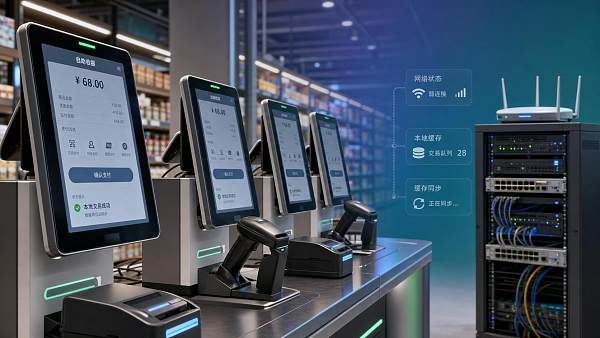
Retail edge computing improves POS by processing transactions, promotions, and device coordination at the store level.
That is especially useful during rush hours, store events, and unstable network periods.
Where edge-enabled POS creates value
- Local transaction caching reduces checkout disruption during connectivity issues.
- On-site promotion logic applies discounts without waiting for cloud confirmation.
- Printer, scanner, and payment peripherals stay synchronized through local orchestration.
- Security controls can flag unusual transaction patterns in real time.
- Store managers gain faster exception handling for refunds, voids, and price overrides.
This matters even more in stores with mixed payment flows.
Thermal printers, barcode systems, e-payments, and loyalty programs all compete for timing precision.
A strong retail edge computing layer keeps those interactions smooth without overloading central systems.
Best use case 2: Vision AI for smarter shelves and unmanned retail
Vision AI is one of the clearest wins for retail edge computing.
Video streams are heavy, constant, and sensitive from a privacy standpoint.
Processing them locally is usually faster, cheaper, and easier to govern.
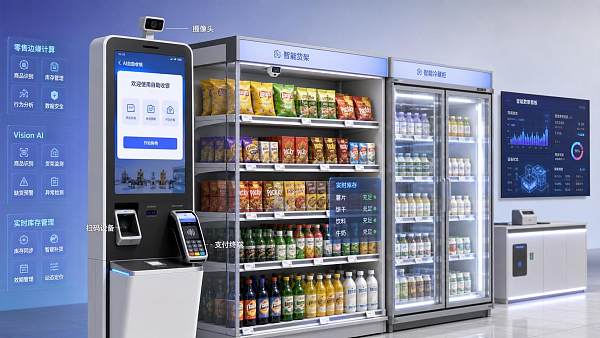
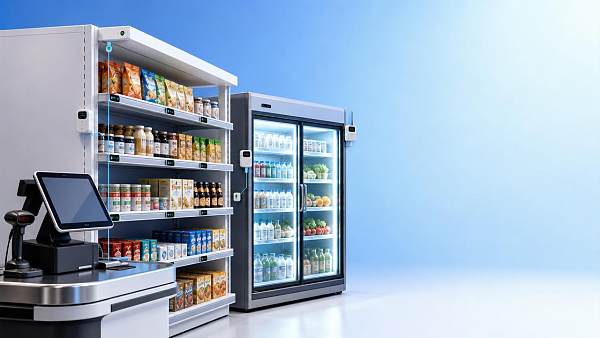
That is why smart fridges, grab-and-go cabinets, and unmanned kiosks increasingly rely on edge inference.
High-impact Vision AI scenarios
- Item recognition in smart vending and smart fridge environments.
- Shelf gap detection for rapid replenishment.
- Planogram compliance checks across chain stores.
- Queue monitoring for dynamic labor allocation.
- Suspicious behavior detection for shrink control.
Consider an unmanned refrigerated cabinet.
The customer scans, opens the door, takes products, and leaves.
Billing accuracy depends on identifying product movement almost instantly after the door closes.
Retail edge computing handles the image analysis on site, not across a delayed network path.
That improves customer experience and reduces the risk of disputed transactions.
There is another advantage.
Local inference allows stores to send metadata instead of raw video whenever possible.
That lightens bandwidth demand and supports stronger privacy practices.
Best use case 3: Inventory accuracy in real time
Inventory errors hurt sales, labor efficiency, and customer trust.
The problem is bigger in fresh retail, convenience formats, and multi-temperature operations.
Retail edge computing helps by merging signals from cameras, POS, RFID, smart shelves, and backroom devices locally.
That creates faster inventory updates and more useful alerts at the point of action.
Practical inventory applications
- Detect low stock before shelves look empty.
- Reconcile sales and stock movement closer to real time.
- Flag temperature-sensitive product risk in refrigerated zones.
- Prioritize replenishment tasks by demand and shelf value.
- Reduce waste by monitoring expiration and turnover patterns.
In food retail, this can go beyond stock counting.
Edge nodes can correlate cooler temperature anomalies with exposed inventory positions.
If an open display case loses thermal stability, staff can act before product quality drops.
That is a strong example of retail edge computing linking operations, compliance, and margin protection.
What a strong edge architecture looks like
Not every store needs the same design.
Still, the most effective retail edge computing deployments share a few common traits.
- A local compute layer for POS, video inference, and sensor aggregation.
- Offline-first operation for payments, alerts, and basic workflows.
- Centralized cloud management for updates, reporting, and model lifecycle control.
- Role-based security, device authentication, and encrypted data movement.
- Modular integration with scanners, printers, cameras, refrigeration, and ERP systems.
This hybrid model keeps stores responsive while preserving corporate visibility.
It also scales better across chains with different footprints, formats, and network quality.
Key risks and how to avoid them
Retail edge computing delivers clear upside, but weak planning can dilute returns.
The most common issues are predictable:
- Overbuilding hardware for low-value use cases.
- Running isolated pilots without integration into POS or inventory workflows.
- Ignoring device management, patching, and security maintenance.
- Using Vision AI models that fail in real lighting or product conditions.
- Measuring technical outputs instead of business outcomes.
A safer approach is to start with one operational bottleneck.
Choose a use case with measurable latency, shrink, labor, or uptime impact.
Then expand only after the store team can prove repeatable value.
How to prioritize the first retail edge computing projects
A simple prioritization framework works well.
Score each candidate project against four questions.
- Does the use case require low latency or offline continuity?
- Does it improve revenue, labor productivity, or asset protection?
- Can it reuse existing store devices and infrastructure?
- Can success be measured within one quarter?
Projects that score high usually sit in POS resilience, unmanned retail, and shelf visibility.
These areas produce visible operational results and generate internal support quickly.
They also create a foundation for broader store intelligence later.
Final take
Retail edge computing is no longer just a technical upgrade.
It is becoming a practical operating model for stores that need speed, autonomy, and resilience.
The best use cases are not abstract.
They show up at the checkout lane, inside smart cabinets, and across inventory decisions made every hour.
For retailers balancing customer experience, labor pressure, food safety, and energy-sensitive assets, the opportunity is immediate.
Start with one high-friction scenario.
Build the retail edge computing layer around measurable store outcomes.
That is usually the fastest path from pilot interest to chain-wide operational value.
Recommended News
 Jun 21, 2026How to Handle Retail Weak-Network Concurrency in Self-Checkout and Smart POS DeploymentsRetail weak-network concurrency can cripple self-checkout and smart POS performance. Learn practical ways to reduce retries, protect payments, and keep stores running smoothly at peak hours.
 Jun 18, 2026Trade Secret Rules Raise Export Compliance for AI DevicesTrade secret rules raise export compliance for AI devices from June 1, 2026. Learn how Smart POS terminals, firmware, and AI model transfers may trigger security assessment risks.
 Jun 17, 2026Retail Edge Computing for Stores: Best Use Cases for POS, Vision AI, and InventoryRetail edge computing helps stores speed up POS, power Vision AI, and improve real-time inventory accuracy. Explore top use cases that boost uptime, reduce shrink, and drive smarter retail operations.
 Jun 14, 2026Retail Automation Systems for Small Stores: What to Automate First and WhyRetail automation systems for small stores should start where profit leaks first. Learn whether to automate POS, inventory, refrigeration, or self-service for faster ROI.
 Jun 13, 2026EU-China Talks Put Smart POS on Priority Access TrackSmart POS enters the EU-China priority access track as talks explore mutual recognition, possible duplicate EMC/EMI test relief, and faster cross-border compliance planning.
 Jun 12, 2026EU-China Talks Put Smart POS on Fast-Track ReviewSmart POS moves into fast-track review as EU-China talks signal easier market access. Learn how CE, GB/T 39932, EMVCo 5.4, and customs changes could reshape sourcing and exports.
 Jun 12, 2026How Retail IoT Interconnection Improves Inventory Accuracy Across POS, Shelves, and Cold StorageRetail IoT interconnection improves inventory accuracy by linking POS, smart shelves, and cold storage in real time—reducing stock errors, shrink, and spoilage while boosting retail efficiency.
 Jun 11, 2026EU-China Talks Put Smart POS on Fast-Track ReviewSmart POS enters fast-track review as EU-China talks advance mutual recognition. Explore how this may cut CE certification time, reshape compliance planning, and impact EU market entry.
 Jun 10, 2026EU-China Talks Put Smart POS Terminals on Fast-Track ReviewSmart POS terminals move into focus as EU-China talks open a fast-track review path. See what this means for compliance, certification, market access, and cross-border trade planning.
 Jun 10, 2026How to Manage Retail Weak-Network Concurrency in Self-Checkout and Smart POS DeploymentsRetail weak-network concurrency explained for self-checkout, smart POS, and unmanned retail. Learn practical edge, sync, and recovery strategies to cut delays and improve uptime.
 Jun 09, 2026China-Europe Talks Put Smart POS on Priority Review ListSmart POS enters priority review in China-Europe talks, signaling possible faster compliance and market access. See what importers, exporters, and retail tech firms should watch next.
![]() Jun 04, 2026FDA Tightens BPA-Free Rules for Food-Contact HousingsFDA Tightens BPA-Free Rules for Food-Contact Housings: learn how the 2026 FDA update impacts smart food equipment, compliance reports, suppliers, and export readiness before deadlines hit.
Jun 04, 2026FDA Tightens BPA-Free Rules for Food-Contact HousingsFDA Tightens BPA-Free Rules for Food-Contact Housings: learn how the 2026 FDA update impacts smart food equipment, compliance reports, suppliers, and export readiness before deadlines hit. Jun 03, 2026Retail Weak-Network Concurrency: How POS Systems Keep Orders SyncedRetail weak-network concurrency keeps POS orders, payments, inventory, and receipts synced during unstable connections—learn how resilient systems prevent costly errors.
 Jun 02, 2026New Retail Revolution: How AI, Self-Checkout, and Smart POS Change StoresNew retail revolution insights: see how AI vision, self-checkout, smart POS, and connected cold-chain systems cut labor, improve hygiene, and boost store profitability.
 Jun 01, 2026Why retail IoT interconnection fails in real storesRetail IoT interconnection fails when real-store networks, protocols, edge devices, and ownership gaps collide. Learn how CRSS helps evaluate resilient, scalable architectures.
 May 31, 2026Why smart retail interconnection still fails in storesSmart retail interconnection fails when devices, data, networks, and workflows are not aligned. See the checklist to reduce downtime, protect sales, and scale connected stores.
 May 30, 2026Why retail IoT interconnection fails in store rolloutsRetail IoT interconnection fails when store rollouts expose weak networks, protocol gaps, edge latency, and unclear ownership. Learn how to evaluate rollout-ready systems.
 May 28, 2026How retail POS terminals cut queues without raising errorsRetail POS terminals help cut queues without increasing errors by speeding scan-to-pay, reducing manual mistakes, and improving checkout resilience—see how modern systems boost store efficiency.
 May 26, 2026How retail checkout terminals cut queues without raising costsRetail checkout terminals help cut queues, speed payments, and reduce checkout friction without increasing labor costs. See how retailers boost efficiency and protect margins.
 May 23, 2026Are retail checkout systems still worth upgrading in 2026?Retail checkout systems are still worth upgrading in 2026 when they improve speed, payment security, uptime, and omnichannel flow. See which retail scenarios deliver the best ROI.
 May 23, 2026ASTM F2100-26 Takes Effect, Antibacterial POS Casings Now RecommendedASTM F2100-26 now recommends antibacterial POS casings—silver-ion & copper-alloy coatings with UL/SGS ISO 22196 certification required for North American pharmacy and C-store deployments. Act now to avoid order delays.
 May 22, 2026Visa CEO's China Visit Spurs Multi-Currency POS MandateVisa CEO's China visit triggers mandatory multi-currency POS compliance for USD/CAD/MXN—key for exporters, OEMs & fintechs. Act now to avoid shipment delays.
 May 20, 2026Retail POS Systems: Hidden Costs in Subscription PricingRetail POS systems may look affordable on subscription, but hidden fees in payments, hardware, support, and integrations can cut ROI fast. Learn what finance teams must check before signing.
 May 20, 2026Retail POS Systems Integration Issues Before Multi-Store RolloutRetail POS systems can fail at scale if ERP, payments, inventory, tax, and printing are not aligned. See the key integration checklist before a multi-store rollout.

Editor's Selection
The Archive Newsletter
Critical industrial intelligence delivered every Tuesday. Peer-reviewed summaries of the week's most impactful logistics and market shifts.